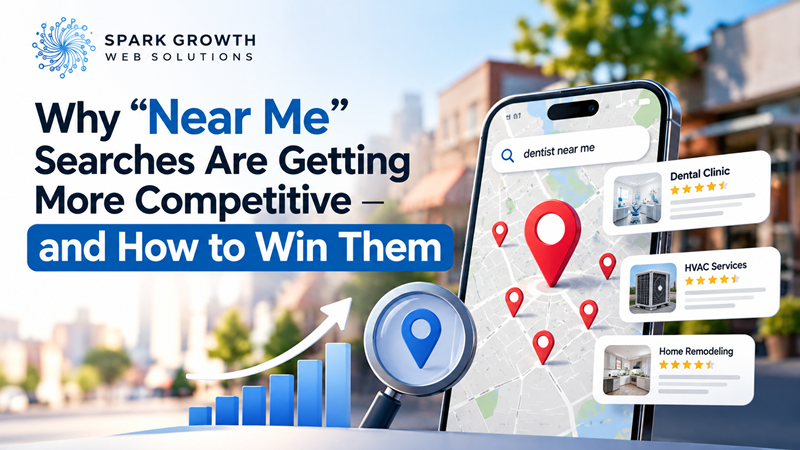
“Near me” searches used to be a relatively easy win for local businesses — show up with a decent Google Business Profile, and you’d get found. That’s changed. As more businesses have caught up on the basics, and as Google surfaces richer local information directly in search results, competition for these exact queries has intensified. SparkGrowth Web Solutions sees this most clearly in dense urban and suburban markets, where a dozen genuinely solid competitors might be fighting for the same handful of local pack positions.
Why “Near Me” Searches Are Getting More Competitive
More Businesses Have Optimized the Basics
A complete Google Business Profile used to be a differentiator. Now it’s closer to table stakes — most legitimate competitors in most industries have at least the fundamentals covered, which raises the bar for what actually stands out.
Google Surfaces More Information Without a Click
Rich local results — reviews, photos, hours, direct booking links — mean a searcher can evaluate several businesses without visiting any website at all, which puts more weight on your Business Profile presentation specifically, not just your website.
Review Volume and Recency Have Become More Central
A business with 200 recent, positive reviews has a real, visible edge over one with 20 reviews from three years ago — and review generation has become a more deliberate, ongoing effort for competitive businesses rather than something left to chance.
What Actually Moves the Needle Now
1. Review Velocity, Not Just Review Count
A steady stream of recent reviews signals an active, currently-operating business more strongly than a large historical total with nothing recent. Building a consistent, low-friction process for requesting reviews after a positive interaction matters more than a one-time push.
2. Genuinely Complete Category and Service Information
Precise primary and secondary categories, and services listed with real descriptions rather than bare labels, directly affect which specific “near me” queries you’re eligible to appear for.
3. Photos That Are Recent and Specific
Generic or outdated photos underperform recent, specific images — actual work completed, the real storefront, the current team — both for engagement and for the trust signal they send.
4. Responding to Every Review
Active engagement with reviews, especially negative ones handled well, differentiates a business that’s clearly attentive from one that set up a profile and walked away.
5. Location-Specific Content on Your Website
A website with genuine, specific content about the areas you serve — not just a city name dropped into a page for the sake of it — supports the relevance signal that both search engines and searchers respond to.
6. Consistent NAP Across Every Listing
As covered in our guide to local citations, inconsistent business information across directories undermines the trust signal that supports local ranking, even when your primary Business Profile is otherwise strong.
What Doesn’t Help as Much as It Used To
Simply having a listing, without ongoing maintenance, is no longer enough to compete in most markets. Keyword-stuffing your business name (against Google’s guidelines, and increasingly penalized) provides no real advantage and risks suspension. A one-time optimization push without ongoing attention tends to plateau or decline as competitors who maintain their profiles actively pull ahead.
Where to Focus If You’re Starting From Behind
Start with review velocity and category precision — both are high-impact and don’t require any website changes. From there, layer in consistent content and citation work. If you want a clear picture of exactly where you stand against local competitors, SparkGrowth Web Solutions can run a local competitive audit and show you specifically what’s closing the gap for competitors currently outranking you.
Frequently Asked Questions
How many reviews do I need to compete for “near me” searches?
There’s no fixed number — it’s relative to your specific competitors in your specific area. A competitive audit of your actual local market is more useful than a generic target.
Does responding to reviews actually affect rankings?
It’s treated as an engagement and trust signal, and it directly affects how potential customers perceive your business when comparing options in local results.
Is paid advertising a substitute for local SEO for “near me” queries?
It can provide visibility, but paid placements don’t build the same lasting local trust signals, and most searchers still engage significantly with organic local results.