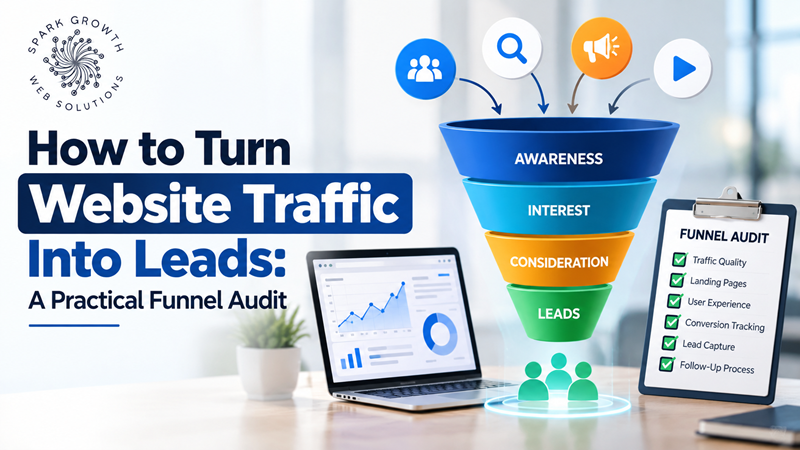
Traffic growth gets celebrated, and it should be — but traffic alone doesn’t pay bills. A site pulling in thousands of monthly visitors that converts almost none of them into leads has a funnel problem, not a traffic problem, and no amount of additional SEO or ad spend fixes a leaky funnel. SparkGrowth Web Solutions runs a funnel audit before recommending more traffic investment to any client, because the fix is often cheaper and faster than the client expects.
Why Traffic Growth Alone Is a Trap
If your conversion rate is fixed at, say, 1%, doubling your traffic doubles your leads — but fixing a funnel problem that’s suppressing conversion to 2% has the exact same effect, often for far less cost than doubling traffic through SEO or ads. Most businesses default to chasing more traffic because it feels more directly actionable, while funnel issues can feel vague or hard to diagnose. They’re not, once you know where to look.
The Funnel Audit: Where to Actually Look
Stage 1: Landing Page Relevance
Does the page a visitor actually lands on match what brought them there? A visitor searching for a specific service who lands on a generic homepage, rather than a page directly addressing that service, faces unnecessary friction before they even see relevant information.
Stage 2: Message Match and Clarity
Within the first few seconds on a page, can a visitor tell what you offer and whether it’s relevant to them? Vague, jargon-heavy messaging costs conversions at this exact stage, before a visitor ever reaches your call to action.
Stage 3: Trust and Credibility Signals
Does the page give a visitor real reasons to trust you specifically — testimonials, real results, clear credentials — or does it just assert quality without evidence? This stage is where a lot of otherwise decent pages quietly lose visitors who are close to converting but not quite convinced.
Stage 4: The Call to Action Itself
Is there one clear, obvious next step, or several competing options that dilute focus? A page with a single, well-placed action reliably outperforms one asking a visitor to choose between multiple equally-weighted options.
Stage 5: The Contact or Conversion Point
Is your form asking for more than it needs to at this stage? Are there unexpected obstacles — unclear next steps after submission, no confirmation, a broken mobile experience? This is where abandonment specifically happens, and it’s often the single highest-leverage stage to fix.
How to Actually Run This Audit on Your Own Site
- Pull your analytics for your top landing pages by traffic — these deserve the most attention first, since fixes here affect the most visitors.
- Check bounce rate and time on page for each — a high bounce rate on a page with relevant traffic often points to a message-match problem at stage 1 or 2.
- Walk through each stage yourself as a stranger would — genuinely pretend you’ve never seen the site before and see where you’d hesitate.
- Check your form or contact funnel for actual drop-off data, not just overall conversion rate — knowing exactly which step loses people tells you precisely what to fix.
Where to Focus First
Start with your highest-traffic pages that have the worst conversion performance — that’s where a fix affects the most visitors immediately. A low-traffic page with poor conversion matters less in absolute terms, even if the percentage looks worse.
If you’re driving significant traffic through SEO but not seeing proportional leads, this audit is usually the first thing worth doing before investing in more traffic. SparkGrowth Web Solutions can run this funnel audit against your actual site and show you exactly where visitors are dropping off.
Frequently Asked Questions
What’s a good traffic-to-lead conversion rate?
It varies enormously by industry and traffic source, which makes your own trend over time more useful than comparing to a generic external benchmark.
Should I fix my funnel before or after investing in more SEO?
Generally before, or at least alongside — improving conversion on existing traffic is usually cheaper than acquiring new traffic, and the improvement compounds once you do grow traffic further.
How long does a funnel audit take?
For a site with existing analytics set up properly, a thorough audit can typically be completed within a few days; setting up proper tracking first, if it’s missing, adds time upfront.