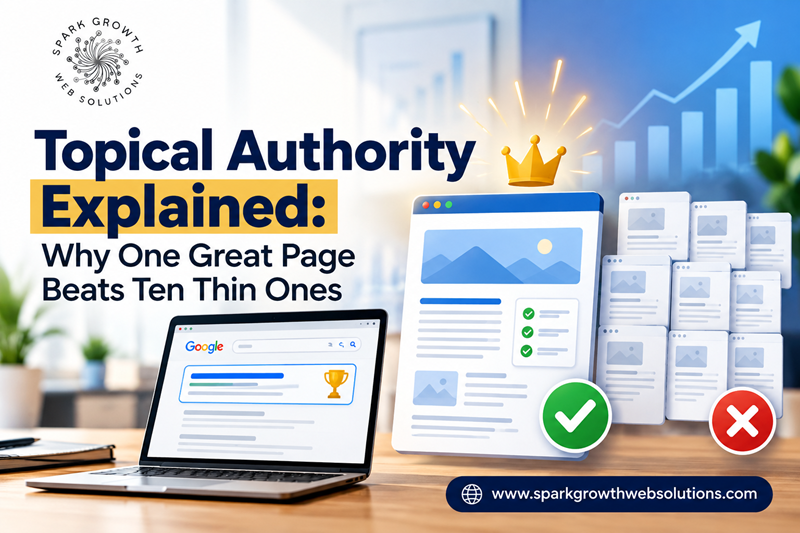
A common instinct in content strategy is to publish more: a separate page for every keyword variation, every close synonym, every slightly different phrasing of the same question. It feels productive. It’s usually counterproductive. Search engines increasingly reward depth and genuine authority on a topic over sheer page count, and SparkGrowth Web Solutions sees this pattern play out constantly — a site with fifty thin pages consistently underperforms a site with fifteen genuinely thorough ones.
What Topical Authority Actually Means
Topical authority is the degree to which search engines (and, increasingly, AI-generated answer systems) consider a site a genuinely comprehensive, trustworthy source on a given subject — not just a single page that happens to rank for one query, but a body of content that demonstrates real depth and connected expertise across a topic.
It’s built less through any single page and more through how a site’s content relates to itself: how thoroughly it covers a subject’s natural sub-questions, how well those pages link to and reinforce each other, and whether the overall pattern reads as genuine expertise rather than a scattered attempt to rank for as many terms as possible.
Why More Pages Often Backfires
Thin Content Dilutes Rather Than Multiplies
Ten pages each covering one narrow angle of a topic, none of them thoroughly, tend to individually underperform one page that covers the topic properly. Search engines can generally distinguish a genuinely useful comprehensive resource from a keyword-variation farm.
It Fragments the Signals That Build Authority
Backlinks, engagement, and internal links spread thin across many weak pages accomplish less than the same signals concentrated on fewer strong ones. A single authoritative page attracts more of all three than ten scattered ones combined.
It Risks Running Into Scaled Content Policies
Google’s own guidance is explicit that creating pages primarily to capture query variations — rather than to genuinely help a reader — can trigger scaled content abuse policies. This isn’t a hypothetical risk; it’s an active enforcement area.
What Building Genuine Topical Authority Looks Like
1. Map the Topic Before Writing Anything
Identify the core questions a real customer would have about a topic, including the ones they wouldn’t think to search for directly but would still want answered. This becomes your actual content plan, not a keyword list.
2. Build Comprehensive Pages, Not Narrow Ones
A single page that thoroughly answers a topic’s main question and its natural sub-questions will generally outperform several separate pages each targeting one narrow slice of the same territory.
3. Link Related Content Deliberately
Internal links between genuinely related pieces of content — not just navigational links — reinforce the pattern that a site has real depth on a subject, and help both readers and search engines move naturally between related material.
4. Update Existing Pages Instead of Publishing New Ones for Small Variations
If a new keyword variation is closely related to an existing page’s topic, expanding that page is usually the better move than creating a new, thinner one that competes with it for the same intent.
5. Let Depth Compound Over Time
Topical authority isn’t built in one publishing sprint — it accumulates as a site consistently adds genuine depth to a subject area over months and years, which is one reason a documented, sustained content strategy outperforms sporadic, disconnected publishing.
A Practical Test
Before publishing a new page, ask: does this genuinely add something an existing page on the site doesn’t already cover, or is it a narrower slice of the same territory? If it’s the latter, the better move is almost always to expand the existing page rather than fragment the topic further.
This same discipline matters for how content gets cited in AI-generated search summaries too — our guide on AI Overviews and search visibility covers why comprehensive, well-structured pages tend to get referenced more reliably than narrow ones.
If your site has accumulated a lot of thin, overlapping content and you’re not sure where to consolidate, SparkGrowth Web Solutions can map your existing content against your actual topic areas and show you exactly where to combine, expand, or retire pages.
Frequently Asked Questions
How many pages does it take to build topical authority?
There’s no fixed number — it depends on how genuinely broad the topic is. The measure is comprehensiveness and depth, not a page count target.
Should I delete my existing thin pages?
Often, consolidating them into a stronger, more comprehensive page (with proper redirects) works better than simply deleting them, since it preserves any existing rankings or backlinks while fixing the underlying thinness.
Does topical authority apply to small, local businesses too?
Yes — a local business with genuine, thorough content about its specific services and area builds the same kind of authority within its niche as a larger site does within a broader one.