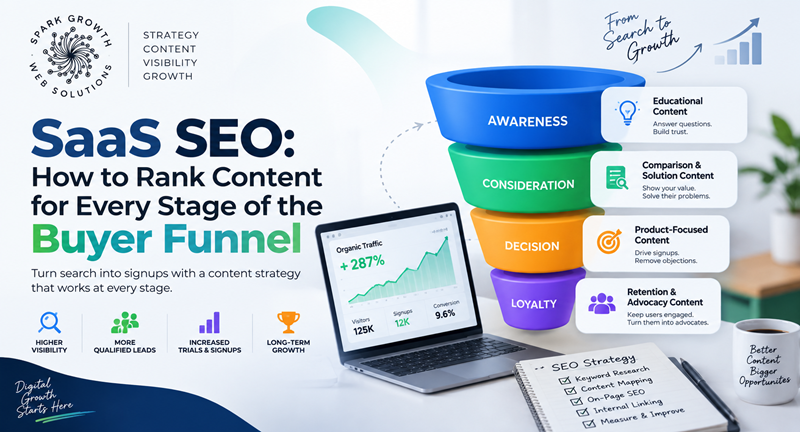
Most SaaS content strategies chase the same handful of high-volume, high-competition keywords — “[category] software,” “best [category] tool” — while ignoring the much larger volume of searches happening earlier and later in the buyer’s decision process. SaaS SEO built around the full funnel, not just bottom-funnel comparison terms, captures buyers earlier, builds trust before the sales conversation starts, and competes on far less contested keyword territory.
1. Why Full-Funnel SEO Matters More for SaaS Than Most Industries
SaaS purchases typically involve a longer research cycle than most consumer decisions — a buyer might spend weeks or months identifying a problem, researching approaches, comparing vendors, and building internal buy-in before ever requesting a demo. A content strategy focused only on “vs.” and “best” comparison pages misses nearly the entire research journey, and cedes that early-stage trust-building to competitors.
2. Mapping Content to Each Funnel Stage
Top of Funnel: Problem-Aware Content
At this stage, the buyer knows they have a problem but hasn’t necessarily identified software as the solution yet. Content here answers “why does this keep happening” and “what’s causing this” — establishing expertise and topical authority long before a purchase decision is even on the table.
Middle of Funnel: Solution-Aware Content
The buyer now knows a category of software could solve their problem and is researching approaches and evaluation criteria. Content here covers “how to choose,” “what to look for,” and category-education pieces that position the product’s approach as sound without yet pushing a hard sell.
Bottom of Funnel: Product-Aware Content
This is where comparison pages, feature breakdowns, pricing pages, and “alternatives to [competitor]” content live — genuinely useful here, but only effective once the earlier-stage content has already built trust and topical authority to support it.
3. Keyword Research for the Full SaaS Funnel
- Mine support tickets and sales call notes for the exact problem language prospects use before they know a product category exists.
- Study competitor comparison and “alternative” pages to understand what bottom-funnel searchers are actually comparing on.
- Layer in “how to” and educational queries around the core problem space — these typically carry far less competition than product-category terms.
- Track branded + competitor search volume as a proxy for genuine bottom-funnel demand worth targeting directly.
Want a full-funnel SEO content strategy built for your SaaS product? Talk to SparkGrowth Web Solutions →
4. Technical Considerations Specific to SaaS SEO
Programmatic and Templated Pages
Integration pages, use-case pages, and industry-specific landing pages can scale efficiently with templates, but each needs genuinely unique, substantive content to avoid thin-content penalties — a swapped headline over identical body copy doesn’t hold up.
Documentation and Help Center Indexing
A well-indexed help center often ranks for long-tail, highly specific queries that marketing content never targets directly, and frequently converts well since the searcher is often already a prospect or existing user.
5. Recommended KPIs to Track
Metric | Funnel Stage |
Organic sessions on problem/educational content | Top of funnel |
Content-to-trial signup rate | Middle of funnel |
Comparison/alternative page conversion rate | Bottom of funnel |
Branded + competitor search visibility | Bottom of funnel |
6. Common Mistakes in SaaS SEO Strategy
- Only targeting bottom-funnel comparison keywords and ignoring the much larger top-of-funnel opportunity.
- Publishing thin, templated programmatic pages without genuine unique value per page.
- Treating the help center as separate from SEO strategy instead of a genuine long-tail content asset.
- Writing comparison content without genuine topical authority behind it, which converts poorly even when it ranks.
7. Conclusion
SaaS SEO that only chases bottom-funnel comparison terms is competing in the most crowded, expensive part of the buyer journey while leaving the much larger top and middle of the funnel to competitors. A genuinely full-funnel content strategy builds trust early, captures a wider range of search demand, and ultimately makes the bottom-funnel comparison content convert better once a prospect finally reaches it.
Explore SparkGrowth’s content marketing services →
Frequently Asked Questions
What’s the difference between top, middle, and bottom-funnel SaaS content?
Top-funnel content addresses the underlying problem before software is even considered; middle-funnel content covers solution research and evaluation criteria; bottom-funnel content covers direct product comparisons and features.
Should SaaS companies prioritize comparison pages first?
Comparison pages convert well, but they perform best when backed by earlier-stage content that’s already built topical authority and trust — starting there alone leaves significant search demand uncaptured.
How do I find top-of-funnel keyword opportunities for SaaS?
Mine support tickets, sales call notes, and community forums for the problem-language prospects use before they know a software category exists.
Can help center content actually help SEO?
Yes — a well-indexed help center frequently ranks for highly specific, long-tail queries that marketing content never directly targets.
How much unique content does a programmatic SaaS page need?
Enough genuine, substantive detail specific to that page’s use case or integration — a swapped headline over otherwise identical content risks being treated as thin or duplicate content.