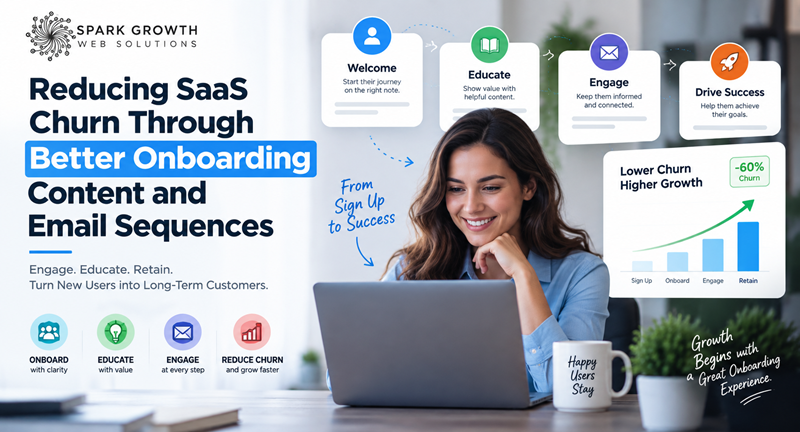
Most SaaS churn doesn’t happen because a product fails to deliver value — it happens because a new user never got far enough to experience that value in the first place. Reducing SaaS churn through better onboarding content and email sequences addresses the highest-leverage moment in the entire customer lifecycle: the first days and weeks, when the habit of using the product either forms or doesn’t.
1. Why Onboarding Is the Highest-Leverage Point for Churn Reduction
Churn analysis across SaaS products consistently shows the same pattern: users who reach a meaningful first “success moment” quickly are dramatically more likely to stick around than users who don’t. Onboarding content and email sequences exist to engineer that early success deliberately, rather than hoping users find it on their own.
2. Defining the “Aha Moment” Before Building Onboarding Content
Every product has a specific action or outcome that correlates most strongly with long-term retention — sending a first campaign, connecting a first integration, inviting a first teammate. Onboarding content and emails should be built entirely around getting new users to that specific moment as quickly and clearly as possible, rather than covering every feature evenly.
3. Building an Onboarding Email Sequence That Actually Reduces Churn
Day 0: Immediate, Action-Focused Welcome
The first email should point to one specific next action tied to the product’s core value, not a broad feature tour. A single clear call to action outperforms a long list of things a new user “could” do.
Days 1–3: Removing the Most Common Setup Blockers
Early emails should proactively address the specific points where users most commonly get stuck or abandon setup — informed by real support ticket data, not guesswork.
Days 4–7: Reinforcing the Aha Moment
Once a user has reached (or is close to) the core value moment, follow-up content should reinforce it — a case study, a tip for going deeper, or a nudge toward a second meaningful action that builds the habit further.
Days 14–30: Re-Engaging Users Who Haven’t Activated
Users who haven’t reached the core value moment by this point need a different message entirely — often a direct, human check-in or a simplified path back to the single most important action, rather than another automated feature email.
4. In-App Onboarding Content vs. Email
- In-app guidance works best for the immediate, in-the-moment actions — first setup steps, contextual tooltips, and progress checklists.
- Email works best for re-engagement, reinforcement, and reaching users who’ve left the product entirely rather than just paused mid-session.
- The two need to be coordinated, not duplicated — an email nudging a user toward an action they already completed in-app reads as sloppy and erodes trust in the automation.
Want an onboarding content and email strategy built around your product’s real activation data? Talk to SparkGrowth Web Solutions →
5. Recommended KPIs to Track
Metric | Why It Matters |
Time to first “aha moment” | Core predictor of long-term retention |
Onboarding email open/click rates by stage | Shows where messaging is or isn’t landing |
Activation rate within first 7/14/30 days | Direct measure of onboarding effectiveness |
Churn rate by activation status | Confirms the link between early activation and retention |
6. Common Mistakes in SaaS Onboarding Content
- Covering every feature evenly instead of focusing relentlessly on the core activation moment.
- Sending generic, non-personalized sequences regardless of a user’s actual behavior or progress.
- Duplicating in-app and email guidance instead of coordinating them around the same user journey.
- Never revisiting the sequence after the initial build, even as product features and activation data change over time.
7. Conclusion
Onboarding content and email sequences are one of the few churn-reduction levers a SaaS company controls almost entirely on its own. Built around a clearly defined activation moment, with content coordinated across in-app and email rather than duplicated, onboarding becomes the difference between a user who forms a habit and one who quietly disappears in the first week.
Explore SparkGrowth’s content marketing services →
Frequently Asked Questions
What is the “aha moment” in SaaS onboarding?
It’s the specific action or outcome that correlates most strongly with long-term retention for a given product — the moment a new user experiences the product’s core value directly.
How long should an onboarding email sequence run?
Most effective sequences run at least 30 days, with distinct messaging for immediate setup, early reinforcement, and re-engaging users who haven’t yet activated.
Should onboarding content be the same for every user?
No — the most effective onboarding adapts based on what a user has and hasn’t done, rather than sending an identical sequence to everyone regardless of behavior.
Does in-app onboarding replace the need for onboarding emails?
No — they serve different purposes; in-app guidance handles in-the-moment actions, while email is better suited to re-engaging users who’ve left the product entirely.
How do I know which onboarding step causes the most drop-off?
Analyzing product usage data alongside support tickets typically reveals the specific setup steps or actions where users most commonly get stuck or abandon onboarding.