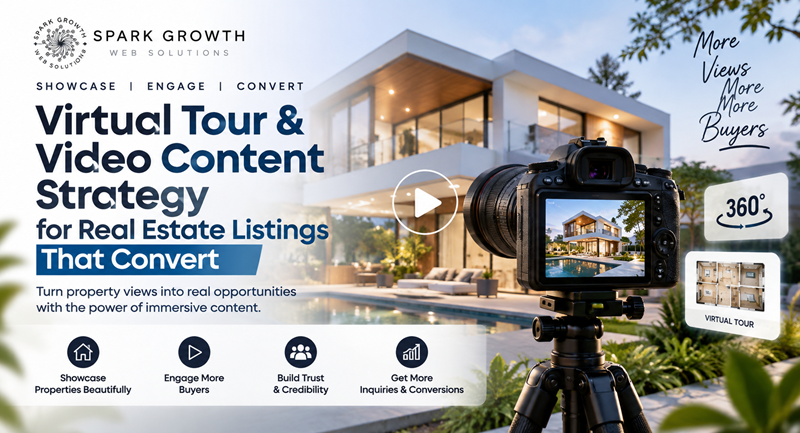
Static photos are still the baseline for a real estate listing, but they’ve stopped being the differentiator. Buyers scrolling through dozens of similar listings in a single search session give a virtual tour or video walkthrough far more attention than a photo gallery — and Google itself increasingly surfaces video content prominently for local, visual-intent searches like real estate. Virtual tour and video content strategy has moved from a luxury add-on to a genuine competitive advantage for agents willing to invest in it.
1. Why Video Content Outperforms Photos for Real Estate
A photo gallery asks a buyer to mentally reconstruct the flow of a home from static frames. A walkthrough video or 3D virtual tour does that work for them, communicating scale, natural light, and room flow in a way still images simply can’t. Listings with video consistently see longer engagement time and more serious inquiry volume than photo-only listings — buyers self-select into contacting an agent after a video tour with a clearer sense of genuine interest.
2. Choosing the Right Video Format for Each Listing
Full Walkthrough Videos
A narrated or captioned room-by-room walkthrough works best for higher-value listings where buyers are willing to invest several minutes — it builds the most complete picture but requires the most production effort.
3D Virtual Tours (Matterport-Style)
Interactive, self-guided 3D tours let buyers explore at their own pace and are particularly effective for out-of-town or relocating buyers who can’t easily visit in person before making a decision to view further.
Short-Form Highlight Reels
A 30-to-60-second highlight video, built for social platforms and listing previews, drives initial interest and clicks even when the buyer hasn’t committed to watching a full walkthrough yet.

3. Getting Video Content Found in Search
- Host video on the listing page itself, not only on a third-party platform, so the page benefits directly from the engagement signal.
- Use VideoObject schema to help search engines understand and potentially surface the video in rich results.
- Write a genuine, descriptive title and transcript rather than a generic “Listing Video” label — specific, keyword-relevant descriptions help both search visibility and accessibility.
- Publish a companion blog post or listing description around notable video content, giving search engines substantial surrounding text to index alongside the video itself.
Want a content strategy that makes the most of your listing videos and tours? Talk to SparkGrowth Web Solutions →
4. Production Considerations That Actually Matter
Lighting Over Equipment
Natural, well-timed lighting (shooting during the “golden hour” or on a bright, overcast day) makes a bigger visible difference than expensive camera gear — a well-lit space shot on a mid-range camera consistently outperforms a poorly lit space shot on premium equipment.
Consistent Style Across a Portfolio
A consistent visual style, pacing, and branding across an agent’s video content builds recognizable authority over time, rather than each listing feeling like a one-off production.
5. Recommended KPIs to Track
Metric | Why It Matters |
Video completion rate | Indicates genuine buyer interest depth |
Listing page time-on-page with video vs. without | Direct comparison of video’s engagement impact |
Inquiry rate from video-enabled listings | Ties video investment to actual lead generation |
Organic search visibility for video-enabled pages | Confirms video/schema is supporting SEO, not just engagement |
6. Common Mistakes With Real Estate Video
- Publishing video only on social platforms, missing the SEO and engagement benefit of hosting it on the listing page itself.
- Shaky, poorly lit footage that undercuts an otherwise strong listing.
- No schema markup, leaving search engines with no structured way to understand or surface the video content.
- Inconsistent format and quality across listings, which weakens an agent’s overall brand impression over time.
7. Conclusion
Video and virtual tour content has shifted from a differentiator to close to table stakes in competitive real estate markets. Agents who invest in a consistent, well-produced, search-optimized video strategy — rather than treating it as an occasional add-on — build both stronger individual listing performance and a more recognizable, trustworthy brand across their entire portfolio.
Explore SparkGrowth’s content marketing services →
Frequently Asked Questions
Do virtual tours actually increase real estate inquiries?
Yes — listings with video and virtual tours consistently see longer engagement and more qualified inquiry volume compared to photo-only listings.
Should I use a full walkthrough video or a 3D virtual tour?
It depends on the listing and audience — 3D tours work especially well for remote or relocating buyers, while full walkthrough videos suit higher-value listings where buyers will invest more time.
Does video content help SEO for real estate listings?
Yes, when hosted on the listing page itself with VideoObject schema and descriptive text, video content can support both engagement metrics and search visibility.
What matters more for real estate video — equipment or lighting?
Lighting generally has a bigger visible impact than camera equipment — well-lit footage on mid-range gear consistently outperforms poorly lit footage from premium cameras.
Should every listing get a video, regardless of price point?
Not necessarily a full production for every listing, but at minimum a short highlight reel is worth the investment given how much buyer attention video content captures relative to photos alone.