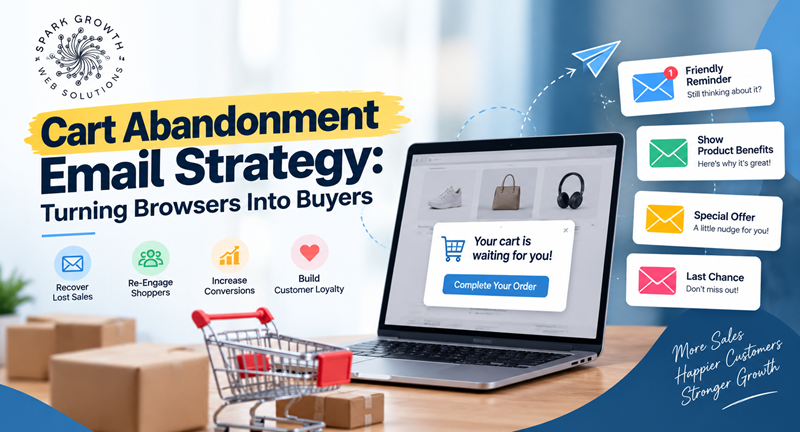
The majority of online shopping carts are abandoned before checkout completes — not because shoppers changed their minds entirely, but because of unexpected shipping costs, a distraction, or simple hesitation at the final step. Cart abandonment email strategy exists to recover as much of that lost revenue as possible, and a well-built sequence consistently recovers a meaningful share of otherwise-lost sales.
1. Why Cart Abandonment Emails Work
Someone who added a product to their cart has already cleared the hardest part of the funnel — product discovery and initial interest. Abandonment doesn’t usually mean disinterest; it more often means a hesitation, distraction, or a small unresolved question that a well-timed, well-crafted email can resolve. That’s why cart abandonment emails consistently show some of the highest open and conversion rates of any automated email type.
2. Building an Effective Cart Abandonment Sequence
Email 1 (1 Hour Later): The Gentle Reminder
A simple, friendly reminder showing the exact items left in the cart, with a direct link back to checkout, performs best this early — no discount needed yet, since many abandonments at this stage are simple distraction rather than genuine hesitation.
Email 2 (24 Hours Later): Address Common Hesitations
This email should proactively answer the objections most likely to have caused hesitation — shipping costs, return policy, sizing or fit questions — rather than just repeating the reminder.
Email 3 (48–72 Hours Later): A Time-Limited Incentive
For shoppers who still haven’t returned, a modest, genuinely time-limited discount or free shipping offer can be the final nudge — but this should be reserved for the last email in the sequence, not used immediately, to avoid training customers to always wait for a discount.
3. What Makes a Cart Abandonment Email Actually Convert
- Show the actual abandoned products, with images, rather than a generic “you left something behind” message.
- One clear call to action — a direct link back to checkout with the cart already populated, removing any friction to complete the purchase.
- Genuine urgency, not manufactured pressure — a real stock or price-hold deadline reads as legitimate; a vague “hurry, offer ends soon” on every email erodes trust over time.
- Mobile-optimized design, since a large share of cart abandonment emails are opened and acted on from a phone.
Want a cart abandonment sequence built and tested for your store? Talk to SparkGrowth Web Solutions →
4. Beyond Email: Reducing Abandonment at the Source
Surface Shipping Costs Earlier
Unexpected shipping costs at the final checkout step are one of the most common abandonment triggers — showing estimated costs earlier in the shopping flow reduces this specific friction point before an email sequence is even needed.
Simplify the Checkout Process Itself
Every unnecessary form field or required account creation step adds friction; a genuinely simple, guest-checkout-friendly flow reduces abandonment at the source, complementing rather than replacing the email recovery strategy.
5. Recommended KPIs to Track
Metric | Why It Matters |
Cart abandonment recovery rate | Direct measure of sequence effectiveness |
Open/click rate per email in the sequence | Shows which specific message is or isn’t landing |
Revenue recovered per sequence send | Ties the strategy directly to bottom-line impact |
Discount redemption rate on email 3 | Confirms whether the incentive step is actually needed |
6. Common Mistakes in Cart Abandonment Email Strategy
- Leading with a discount immediately, training customers to always abandon and wait for a coupon.
- Sending only one generic reminder instead of a sequence that addresses different reasons for hesitation.
- Poor mobile formatting, losing conversions from the large share of opens that happen on a phone.
- Never addressing the root causes of abandonment (shipping costs, checkout complexity) alongside the email recovery strategy.
7. Conclusion
Cart abandonment emails work because most abandonment isn’t genuine disinterest — it’s hesitation, distraction, or an unresolved question a well-timed sequence can answer. A three-email sequence that reminds, then addresses objections, then offers a genuine incentive as a last resort consistently recovers meaningful revenue that a single generic reminder leaves on the table.
Explore SparkGrowth’s content marketing services →
Frequently Asked Questions
How many emails should a cart abandonment sequence include?
Most effective sequences use three emails — an initial reminder, a follow-up addressing common objections, and a final time-limited incentive for shoppers who still haven’t returned.
Should the first cart abandonment email include a discount?
Generally no — leading with a discount immediately can train customers to always abandon and wait for a coupon; reserve incentives for later in the sequence.
When should the first cart abandonment email be sent?
Around one hour after abandonment tends to perform well — early enough to catch genuine distraction-based abandonment, without feeling immediate or intrusive.
What’s the most common reason shoppers abandon carts?
Unexpected costs at checkout, particularly shipping fees revealed only at the final step, are among the most frequently cited abandonment triggers.
Do cart abandonment emails work on mobile?
Yes, and increasingly so — a large share of these emails are opened and acted on from a phone, making mobile-optimized design essential.