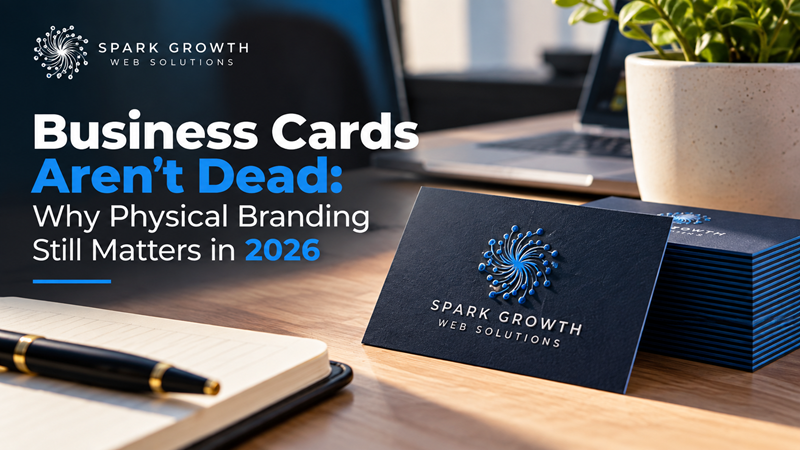
In a world of QR codes, digital contact sharing, and LinkedIn connections, it’s easy to assume the business card has quietly become obsolete. It hasn’t — and dismissing physical branding entirely misses something digital touchpoints genuinely can’t replicate. SparkGrowth Web Solutions still includes business card and printed material design as a core part of branding work, precisely because clients keep telling us it matters more than they expected.
Why Physical Branding Still Has Real Value
Tangibility Creates a Different Kind of Impression
A well-designed, quality business card is a physical object someone holds, looks at, and potentially keeps — a sensory experience a digital contact exchange simply doesn’t offer. Weight, texture, finish: these register, even if only subconsciously, in a way a saved contact entry doesn’t.
It Signals Effort and Legitimacy
A thoughtfully designed card suggests a business that pays attention to detail across the board — an inference that, fairly or not, extends to how someone assumes you’ll handle their actual project or purchase.
It Works Where Digital Doesn’t
Trade shows, in-person meetings, and networking events still happen constantly, and a card handed over in that moment often gets referenced later in a way a quickly-forgotten digital exchange doesn’t.
It Reinforces Brand Consistency
A card that matches your digital brand exactly — same logo, same colors, same tone — reinforces the same trust-building consistency we’ve covered elsewhere; a card that doesn’t match undermines it in exactly the same way an inconsistent website does.
What Makes a Business Card Actually Effective in 2026
- Current logo and brand colors, matching your digital presence exactly — not an older version still in circulation
- A QR code linking directly to your website, portfolio, or a digital contact card — bridging the physical object to a digital next step
- Quality material and finish appropriate to your industry — a premium finish signals differently than a basic matte card, and the right choice depends on your specific positioning
- Uncluttered, legible design — resist the urge to cram every possible detail onto a small physical object; a phone number and a QR code often outperform a card trying to list everything
Beyond Business Cards: Other Physical Touchpoints Worth Attention
- Signage — for any business with a physical location, matching current branding rather than an outdated version
- Packaging, for any business that ships or hands over physical products — an often-overlooked brand touchpoint
- Printed proposals or presentation materials — a polished, on-brand proposal document leaves a different impression than a generic template
Physical and Digital Branding Should Be One System, Not Two
The most common failure isn’t neglecting physical branding entirely — it’s treating it as separate from digital branding, designed at a different time by a different process, resulting in the exact inconsistency covered in our earlier piece on why consistent branding builds trust. Physical materials should draw from the same master logo files, the same documented color palette, the same voice — not a separate, disconnected design effort.
Where SparkGrowth Web Solutions Can Help
Business card design, presentation design, and broader marketing creatives are part of our graphic design and branding services specifically because physical materials still matter and deserve the same care as a website. If your printed materials haven’t kept pace with your digital brand, get in touch and we’ll bring them back in line.
Frequently Asked Questions
Are digital business cards a better investment than physical ones?
They’re complementary rather than a replacement — digital cards are convenient and eco-friendly, but physical cards still serve a distinct purpose in person that digital exchange doesn’t fully replicate.
How often should business card designs be updated?
Whenever your broader brand identity changes — logo, colors, contact information — cards should be updated in the same pass, not left to catch up later.
Is it worth paying for premium card stock or finishes?
It depends on your industry and positioning — a premium finish supports a premium brand positioning, while it may be unnecessary for a business where that isn’t the relevant signal.