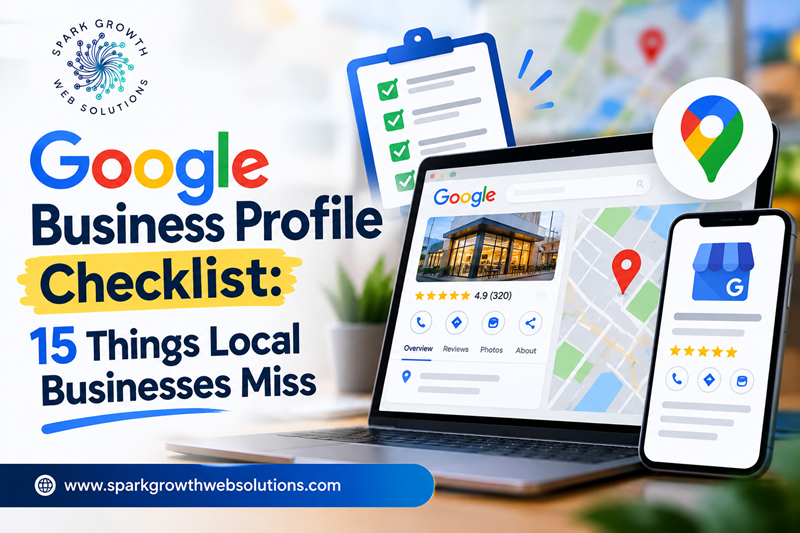
Google is explicit that local search ranking comes down mainly to relevance, distance, and prominence — and a complete, accurate Google Business Profile is one of the clearest ways to strengthen the “relevance” signal directly. Yet in nearly every local audit SparkGrowth Web Solutions runs, we find profiles that were set up once, years ago, and never touched again.
Here’s the full checklist — 15 things, roughly in order of impact, that local businesses consistently miss.
Getting the Basics Genuinely Right
1. Business Name Matches Your Signage Exactly
Google’s guidelines require your listed name to match what customers actually see on your storefront or paperwork — no keywords stuffed in (“SparkGrowth Web Solutions – Best SEO Agency”). This is one of the most common causes of suspended listings.
2. Primary Category Is Precise, Not Generic
“Marketing agency” is vague. “Digital marketing agency” or “Website designer” is specific and matches how people actually search. Your primary category carries more ranking weight than any secondary category you add.
3. Every Relevant Secondary Category Is Added
Most businesses qualify for more categories than they’ve claimed. More accurate categories mean more search queries your profile can legitimately surface for.
4. Service Area Is Set Correctly (Not Just a Pin)
If you serve customers across a region rather than at a single storefront, your service area needs to reflect that explicitly — not just rely on a single map pin to imply it.
Content That Actually Gets Read
5. The Business Description Is Written for Humans
This field is regularly left at the default auto-generated text or filled with keyword-stuffed copy. A clear, specific description of what you actually do and who you serve performs better and reads better.
6. Services Are Listed With Real Descriptions
Adding services as bare labels with no description is a missed opportunity — each service listing is a small chance to include the specific language your customers search for.
7. Products Are Populated If You Sell Anything Physical
The Products section is skipped constantly, even by businesses that have obvious products to list. It’s a direct, visible way to show up in more specific searches.
Photos and Visual Trust Signals
8. Photos Are Recent and Genuinely Represent the Business
Stock photos or images from a launch years ago undercut trust the moment a customer compares them to reality. Fresh, real photos — interior, exterior, team, work in progress — consistently correlate with stronger engagement.
9. A Real Logo Is Set as the Profile Image
Sounds obvious, but a surprising number of profiles still show a placeholder or low-resolution logo.
10. Cover Photo Is Updated Seasonally or by Campaign
Businesses that treat their cover photo as a living asset — updated for a seasonal promotion, a new service, a recent project — tend to see more profile engagement than those that set it once.
Reviews and Reputation
11. There’s an Active Process for Requesting Reviews
Reviews accumulate faster and more genuinely when asking is built into a real process — a follow-up email, a QR code at checkout — rather than left to chance.
12. Every Review Gets a Response
Responding to reviews, positive and negative, signals an active, trustworthy business to both customers and Google. Unanswered negative reviews sitting for months are one of the more damaging patterns we see.
The Details Most Businesses Never Touch
13. Hours Are Accurate, Including Holiday Hours
Incorrect hours don’t just frustrate customers who show up to a closed business — Google has been increasingly proactive about flagging profiles with stale or inconsistent hours.
14. Messaging and Q&A Are Actually Monitored
An open Q&A section with unanswered questions (sometimes answered incorrectly by other users) sits on many profiles indefinitely. Monitoring it takes minutes and prevents bad information from standing unchallenged.
15. Posts Are Published Regularly, Not Just at Setup
Google Business Profile Posts are a low-effort way to show an active business. A profile with one post from two years ago signals neglect in a way that’s easy to fix.
Why This Matters More Than It Might Seem
None of these 15 items are individually dramatic. But local ranking is built from an accumulation of relevance signals, and a genuinely complete, actively maintained profile consistently outperforms one that was set up once and forgotten — regardless of how good the underlying website is. If your website’s SEO and local SEO work isn’t paired with a properly maintained Business Profile, you’re leaving one of the highest-leverage, lowest-cost local ranking factors on the table.
Not sure where your profile currently stands? SparkGrowth Web Solutions can run through this checklist against your actual listing and show you exactly what’s missing.
Frequently Asked Questions
How long does it take to see results after fixing a Google Business Profile?
Some changes, like updated categories or hours, can affect visibility within days. Reputation-related improvements, like review volume, build more gradually over months.
Can too many categories hurt a listing?
Adding categories that don’t genuinely apply to your business can dilute relevance and risk a policy issue — the goal is accuracy, not maximum quantity.
Does a Google Business Profile replace the need for a website?
No — the profile drives local discovery, but the website is still where trust is built and most conversions actually happen.