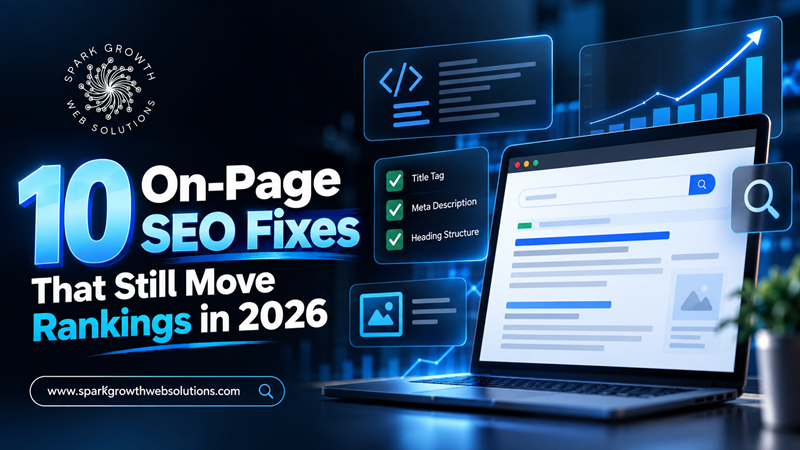
Search has gotten more sophisticated, and it’s tempting to assume that means the basics of on-page SEO matter less than they used to. They don’t. If anything, as AI-generated content floods the web, the sites that still win are the ones getting the fundamentals genuinely right — not the ones chasing the latest trick. At SparkGrowth Web Solutions, on-page work is still where most of our client audits find the fastest, most reliable wins.
Here are 10 on-page fixes that consistently move the needle in 2026, in order of how often we actually find them broken.
1. Title Tags That Match Real Search Intent
A title tag stuffed with keywords but disconnected from what the page actually delivers hurts both click-through rate and rankings. The fix is simple: write the title for the person searching, lead with the specific benefit or answer, and keep the primary keyword near the front without forcing it.
2. One Clear H1, Used Correctly
Every page should have exactly one H1 that states what the page is about in plain language — not a slogan, not a repeat of the title tag verbatim, but a clear statement of the page’s subject. Multiple H1s, or none at all, still confuses both readers and search engines more than most site owners realize.
3. Meta Descriptions Written to Earn the Click
Meta descriptions aren’t a direct ranking factor, but they directly affect whether someone clicks your result over a competitor’s. A meta description that previews the actual value of the page — not a vague summary — consistently outperforms a generic one.
4. A Genuine Heading Hierarchy (H2s and H3s That Mean Something)
Headings should map to how a reader would naturally break the topic into parts, not be inserted every few paragraphs to “look SEO-friendly.” A clean hierarchy helps search engines understand the page’s structure and makes it far easier to skim — which keeps readers on the page longer.
5. Internal Links That Point Somewhere Useful
Internal linking is one of the few SEO levers a site owner fully controls, and it’s still one of the most underused. Every important page should be linked to from somewhere relevant, using descriptive anchor text rather than “click here.” If your SEO service page only gets linked from your main navigation, you’re leaving easy authority on the table.
6. Image Alt Text That Actually Describes the Image
Alt text serves two real purposes: accessibility for people using screen readers, and additional context for search engines about what a page contains. “Image1.jpg” or a keyword crammed in with no relation to the actual image helps neither.
7. URL Structures That Are Short, Readable, and Stable
A URL like /blog/post?id=4471&cat=12 tells a visitor nothing and complicates crawling. A clean, descriptive URL set once and left alone (not changed with every content update) is a small fix with a disproportionately positive effect on both usability and indexing.
8. Content Length That Matches the Question, Not a Word-Count Target
There’s no magic word count that guarantees rankings. A page should be exactly as long as it needs to be to genuinely answer the question — padding a thin answer to hit 2,000 words usually hurts more than it helps, because it buries the actual value under filler.
9. Schema Markup That Matches What’s Actually on the Page
Structured data helps search engines understand specific elements — reviews, FAQs, products, events — but only when it accurately reflects real content on the page. Schema that describes something not genuinely present is a policy violation risk, not a shortcut.
10. Mobile Rendering That Matches Desktop Content
Since Google indexes primarily from the mobile version of a page, any content, links, or structure missing from the mobile rendering effectively doesn’t exist for ranking purposes. Our mobile SEO guide covers this in more depth, but it’s worth repeating here: check what Google actually sees on mobile, not just what looks fine on your desktop monitor.
Where to Start
If you’re working through this list on an existing site, start with numbers 1, 2, and 5 — title tags, heading structure, and internal linking tend to produce the fastest visible movement, because they’re changes search engines can recognize on the very next crawl. The rest compound over time.
None of this requires guesswork. If you want a clear picture of exactly which of these your site is getting wrong, SparkGrowth Web Solutions can run a straightforward on-page audit and show you precisely where the easy wins are.
Frequently Asked Questions
Is on-page SEO still worth the effort in 2026?
Yes — on-page fundamentals remain one of the few parts of SEO a site owner fully controls, and they still directly affect both rankings and how AI-generated search summaries cite pages.
How often should on-page SEO be reviewed?
A full review every 6–12 months is reasonable for most sites, with lighter checks whenever a page is substantially updated.
Do on-page fixes show results quickly?
Some, like title tag and heading fixes, can show movement within days to weeks once a page is recrawled. Others, like content depth improvements, take longer to compound.