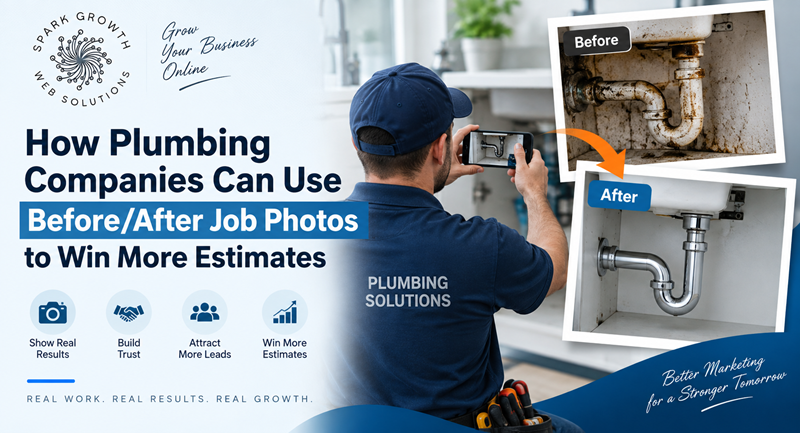
A homeowner comparing three plumbing quotes can’t see the quality of the work behind any of them — pricing looks similar, reviews are scattered across platforms, and every website makes the same claims about reliability. Before/after job photos cut through that sameness instantly: they’re the one piece of marketing content a plumbing company can’t fake, and they answer the question every prospective customer is actually asking — will this job be done right?
1. Why Before/After Photos Outperform Almost Any Other Plumbing Content
Plumbing is largely invisible work — pipes inside walls, water heaters in a closet, drain lines underground. Customers can’t evaluate craftsmanship the way they might judge a visible product, so they rely on proxies: reviews, price, and any visual proof of quality available. Before/after photos are the single most direct proxy a plumbing company can offer, turning invisible expertise into something a prospective customer can actually see and judge for themselves.
2. Building a Before/After Photo System
Make It Part of the Job, Not an Afterthought
Photos taken as a rushed, occasional habit produce inconsistent, low-quality results. Building a simple two-photo requirement into every job’s checklist — one before, one after, same angle where possible — produces a steady library without relying on technicians remembering on their own.
Standardize the Angle and Lighting
A consistent shooting style (same distance, similar lighting, centered on the actual work) makes a photo library look professional and comparable across jobs, rather than a random assortment of phone snapshots.
Get Written Permission Once, Upfront
Building a simple photo-release line into standard job paperwork avoids awkward after-the-fact permission requests and ensures every strong photo can actually be used in marketing.
3. Where to Use Before/After Photos for Maximum SEO and Conversion Value
- Individual service pages — a water heater replacement page with real before/after photos of water heater replacements outperforms generic stock imagery by a wide margin on trust and conversion.
- Google Business Profile — regularly uploaded real job photos are a known engagement signal and directly improve how a listing performs in local search.
- Dedicated project galleries — a browsable portfolio page gives search engines substantial, genuinely unique content to index, unlike thin service pages with little differentiation.
- Review requests — pairing a before/after photo with a review request at project completion gives customers something concrete to reference in their review text.

4. Turning Photos Into SEO-Friendly Content
Descriptive File Names and Alt Text
A file named “water-heater-replacement-phoenix-az.jpg” with matching descriptive alt text gives search engines genuine, specific context — far more useful than a generic “IMG_4821.jpg” upload.
Short Written Context Alongside Each Photo
A sentence or two describing what was done, why, and how long it took turns a photo gallery into genuinely indexable, keyword-relevant content, not just an image dump.
Want your project photos turned into an SEO-optimized gallery? Talk to SparkGrowth Web Solutions →
5. Recommended KPIs to Track
| Metric | Why It Matters |
| Photos added per month | Confirms the photo habit is actually being followed on jobs |
| GBP photo view/engagement metrics | Direct signal of listing engagement and trust |
| Gallery page organic traffic | Shows whether the gallery is earning genuine search visibility |
| Quote-to-close rate on jobs referencing the gallery | Ties photo content directly to conversion, not just visibility |
6. Common Mistakes With Before/After Marketing
- Inconsistent or rare photo-taking, leaving large gaps in the library.
- Low-quality, poorly lit, or cluttered photos that undercut the professionalism they’re meant to demonstrate.
- Uploading photos without any written context or keyword-relevant alt text, wasting their SEO potential.
- Never using the same photos across multiple channels — a strong photo deserves reuse across the website, GBP, and social platforms.
Conclusion
Before/after photos solve the core trust problem every plumbing company faces: customers can’t see the quality of work they’re paying for until it’s done. A consistent, simple photo system, built into the job process, not left to chance, turns everyday work into a steady stream of genuinely persuasive, SEO-valuable content that generic marketing claims simply can’t match.
Frequently Asked Questions
Do before/after photos actually help SEO, or just conversion?
Both — genuinely unique photo content with descriptive alt text and written context gives search engines real material to index, while also building the trust that drives conversion.
How do I get technicians to consistently take photos on every job?
Build a simple two-photo requirement directly into the job checklist or completion paperwork, rather than relying on technicians to remember it on their own.
Do I need customer permission to use job photos in marketing?
Yes — a simple photo-release line built into standard job paperwork upfront avoids awkward after-the-fact permission requests.
Where should before/after photos be published first?
Google Business Profile and the relevant service page tend to offer the fastest visibility and conversion return, with a dedicated gallery page as a strong secondary home.
Does photo quality actually matter, or is any photo better than none?
Quality matters — a poorly lit, cluttered photo can undercut the professionalism it’s meant to demonstrate, so basic consistency in angle and lighting is worth the small extra effort.