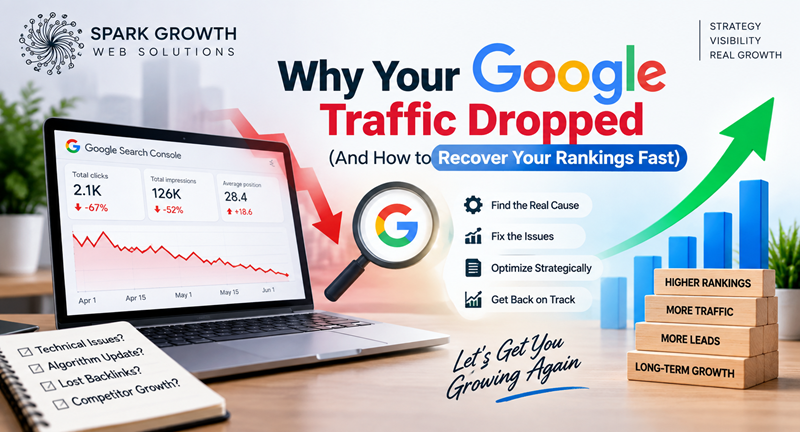
A sudden drop in organic traffic is one of the most stressful things a website owner can see in their analytics — and one of the most common panic reactions is to guess at a fix instead of diagnosing the actual cause. Google traffic drops almost always trace back to one of a handful of root causes, and identifying which one is happening determines the entire recovery strategy.
1. First: Confirm It’s a Real Drop, Not a Measurement Issue
Before diagnosing anything, rule out the boring explanations first:
- Analytics tracking errors — a broken tag, a tracking code removed during a site update, or a misconfigured filter can look identical to a real traffic loss.
- Seasonality — many industries have predictable annual dips; compare year-over-year, not just week-over-week.
- Date range or reporting errors — double-check the comparison period before assuming a genuine drop.
Once a genuine drop is confirmed, the diagnosis process starts with narrowing down which category it falls into.
2. The Five Most Common Causes of a Traffic Drop
Algorithm Updates
Google rolls out core and targeted algorithm updates regularly. A drop that coincides closely with a known update date, and affects a broad set of pages rather than one specific page, points strongly toward an algorithm-related cause.
Technical Issues
A site migration, a botched redesign, a robots.txt change, or an accidental noindex tag can silently deindex pages that were previously ranking well. Technical causes tend to produce sharp, sudden drops rather than gradual declines.
Lost or Broken Backlinks
A drop tied to the loss of a small number of high-authority backlinks — a partner site redesign, a expired sponsorship, a removed guest post — can meaningfully reduce authority signals for the pages that depended on them.
Increased Competition
Sometimes nothing changed on a site at all — a competitor simply outranked it with a stronger page, a new entrant with more authority moved in, or an entire SERP shifted toward different types of results (video, AI Overviews, shopping results) that push organic listings further down the page.
Manual Actions
A manual action — a penalty applied by a human reviewer at Google for a policy violation — produces one of the sharpest, most severe drops of all, and is the one cause with a direct notification in Google Search Console.

3. A Practical Diagnostic Process
- Check Google Search Console for manual actions first — this rules in or out the most severe cause immediately.
- Overlay the drop date against known algorithm update timelines to check for correlation.
- Segment the drop by page and query — a drop concentrated in a handful of pages points to a page-specific issue; a broad, sitewide drop points to a technical or algorithmic cause.
- Check crawl and index status in Search Console for the affected pages — confirm they’re still indexed and haven’t been accidentally noindexed or blocked.
- Review recent site changes — redesigns, migrations, plugin updates, and CMS changes around the time of the drop are frequent culprits.
- Check backlink profile changes using a backlink monitoring tool to spot any recently lost high-authority links.
Seeing a traffic drop you can’t explain? Get a free traffic drop diagnosis from SparkGrowth Web Solutions →
4. Recovery Strategies by Cause
Cause | Recovery Approach |
Algorithm update | Audit content quality and E-E-A-T signals against what the update is known to target; improve rather than revert |
Technical issue | Fix the specific technical fault (noindex, robots.txt, broken redirects) and request reindexing |
Lost backlinks | Rebuild authority through new, genuine link-earning content and outreach rather than chasing the exact lost links |
Increased competition | Analyze what the outranking pages do better and close specific content or authority gaps |
Manual action | Address the specific violation named in Search Console and file a reconsideration request |
5. How Long Recovery Actually Takes
Technical fixes (a wrongly applied noindex tag, a broken redirect) can recover within days to a few weeks once corrected and reindexed. Algorithm-related drops tend to take longer — often until the next related update cycle — since they typically require a genuine content or authority improvement rather than a quick technical patch. Manual action recovery timelines depend on Google’s reconsideration review process, which can take several weeks.
6. Preventing Future Drops
- Monitor Search Console regularly, not just when traffic visibly drops — early warning signs often appear in impressions or average position before traffic collapses.
- Set up alerts for significant week-over-week traffic changes so a drop is caught within days, not discovered a month later in a reporting review.
- Document site changes — a simple changelog of redesigns, migrations, and major content updates makes future diagnosis dramatically faster.
- Maintain a healthy backlink profile proactively, rather than only reacting once a loss is already reflected in rankings.
7. Conclusion
A traffic drop feels like an emergency, but the businesses that recover fastest are the ones that diagnose calmly before reacting — ruling out measurement errors, checking for manual actions, and segmenting the drop by page and query before deciding on a fix. Guessing at a cause and applying the wrong recovery strategy wastes time a genuine diagnosis would have saved from the start.
Explore SparkGrowth’s SEO services →
Frequently Asked Questions
How do I know if my traffic drop is due to a Google algorithm update?
Check whether the drop date lines up closely with a known Google update rollout, and whether the drop affects a broad set of pages rather than one isolated page.
What’s the first thing I should check during a traffic drop?
Google Search Console’s Manual Actions and Security Issues reports — this rules the most severe cause in or out immediately, before investigating anything else.
Can a website redesign cause a traffic drop?
Yes, frequently. Broken redirects, accidental noindex tags, and changed URL structures during a redesign are among the most common technical causes of a sudden drop.
How long does it take to recover from a Google traffic drop?
It depends entirely on the cause — technical fixes can recover in days to weeks, while algorithm-related drops often take longer and require genuine content improvement rather than a quick fix.
Should I disavow lost backlinks that caused a traffic drop?
Disavowing is generally reserved for toxic or spammy links, not naturally lost legitimate ones — for lost legitimate backlinks, rebuilding authority through new content and outreach is usually the better strategy.