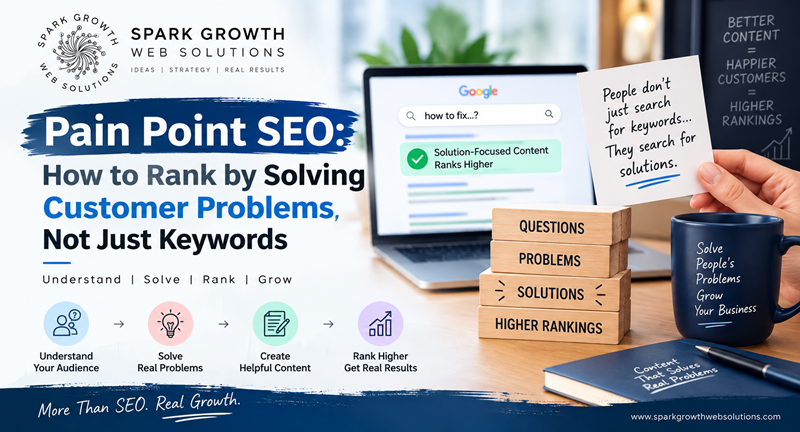
Most keyword research starts and ends with search volume: find the terms people type, build a page around them, done. Pain point SEO flips that process — it starts with the specific problem, frustration, or fear a customer is actually feeling, and works backward to the content and keywords that answer it. The difference sounds subtle, but it changes what gets written, how it ranks, and — most importantly — how well it converts.
1. What Pain Point SEO Actually Means
Traditional keyword strategy asks: “What are people searching for?” Pain point SEO asks a sharper question: “What problem is the person behind this search actually trying to solve, and what’s making it hard for them?”
A traditional keyword approach to “emergency plumber” produces a generic services page. A pain-point approach recognizes that someone searching that phrase at 11pm is anxious, possibly dealing with water damage, and wants to know three things immediately: can someone come now, roughly what will it cost, and can this business be trusted enough to let into their home tonight. The resulting page answers those specific anxieties directly, instead of listing services in the abstract.
2. Why Pain Point Content Tends to Outrank Generic Keyword Pages
- It matches real search intent more precisely, which is increasingly what both traditional ranking algorithms and AI-generated search answers are optimized to reward.
- It naturally produces long-tail, lower-competition phrasing — real problems are usually described in more specific, less-contested language than a generic head-term keyword.
- It converts at a meaningfully higher rate, because the content speaks to the actual hesitation or fear keeping a visitor from taking action, not just the topic in general.
3. How to Find Real Customer Pain Points
Mine Your Own Support and Sales Conversations
The exact phrases customers use when they call, email, or chat in — before they’ve been “cleaned up” into marketing language — are the richest source of genuine pain-point language available, and it’s usually sitting unused in a CRM or support inbox.
Read Reviews (Yours and Competitors’)
Reviews are unfiltered pain-point data. Complaints reveal what competitors are failing to address; praise reveals which specific worries a business successfully resolves for customers — both are direct content material.
Study “People Also Ask” and Community Forums
Google’s own “People Also Ask” boxes, along with forums and community Q&A sites in a given industry, surface the actual follow-up questions and worries real people have — often more specific and emotionally direct than what a keyword tool alone will show.
Talk to the Team on the Front Line
Sales reps, customer service staff, and technicians hear the same objections and worries repeated daily. A short, structured conversation with the team closest to customers routinely surfaces better content ideas than a keyword tool.

4. Turning Pain Points Into Content
Lead With the Problem, Not the Service
A pain-point page opens by naming the frustration directly — “worried your basement flood is going to get worse before help arrives” — rather than opening with a company boilerplate description. This signals immediately that the content understands the reader’s actual situation.
Answer the Anxiety Before the Sale
Cost concerns, trust concerns, and urgency concerns should be addressed explicitly and early, rather than left for a visitor to hunt for or infer. This is also exactly the kind of direct, structured answer content that performs well in AI-generated search overviews.
Use the Customer’s Own Language
Pain-point content should mirror the specific phrasing customers actually use — “why is my water bill suddenly so high” rather than the more formal “detecting hidden plumbing leaks” — since that’s genuinely how the target audience searches and speaks.
Want help mapping your customers’ real pain points into a content strategy? Talk to SparkGrowth Web Solutions about content strategy →
5. Pain Point SEO vs. Traditional Keyword SEO
Traditional Keyword SEO | Pain Point SEO |
Starts with search volume data | Starts with real customer conversations and reviews |
Organized around services or products | Organized around problems and hesitations |
Generic, broadly applicable copy | Specific language mirroring real customer phrasing |
Optimized primarily for ranking | Optimized for ranking and conversion together |
6. Common Mistakes With Pain Point Content
- Guessing at pain points instead of researching them — assumptions about what worries customers are frequently wrong, and real conversation data almost always surfaces different priorities.
- Writing pain-point headlines but generic body copy — the specific, empathetic language needs to carry through the whole page, not just the H1.
- Addressing only one pain point per page when several are layered together — cost, trust, and urgency often all need addressing on the same page, not split awkwardly across separate ones.
- Never updating pain-point content as customer concerns shift — the worries customers had two years ago aren’t necessarily the same ones driving decisions today.
7. Conclusion
Pain point SEO isn’t a replacement for keyword research — it’s a sharper lens for deciding which keywords actually matter and what the content behind them needs to say. Content built around a real, specific customer frustration tends to rank for more precise, lower-competition language while converting noticeably better than generic service copy, because it’s speaking to the actual reason someone is searching in the first place.
Explore SparkGrowth’s content marketing services →
Frequently Asked Questions
How is pain point SEO different from regular keyword research?
Traditional keyword research starts from search volume and topic; pain point SEO starts from the customer’s actual problem or hesitation and works backward to the content and keywords that address it.
Where do I find real customer pain points?
Support tickets, sales call notes, reviews (both a business’s own and competitors’), and direct conversations with front-line staff are the richest sources — better than a keyword tool alone.
Does pain point content still need SEO keyword optimization?
Yes — pain point language and keyword research work together. The goal is finding keywords that match real search intent, phrased the way real customers actually talk.
Is pain point SEO only useful for service businesses?
No — it applies to e-commerce, SaaS, and B2B just as directly. Any purchase decision involves hesitations and problems a business can address head-on in its content.
How often should pain point content be updated?
Whenever customer concerns shift meaningfully — new competitors, pricing changes, or seasonal factors can all change which pain points are actually top of mind.