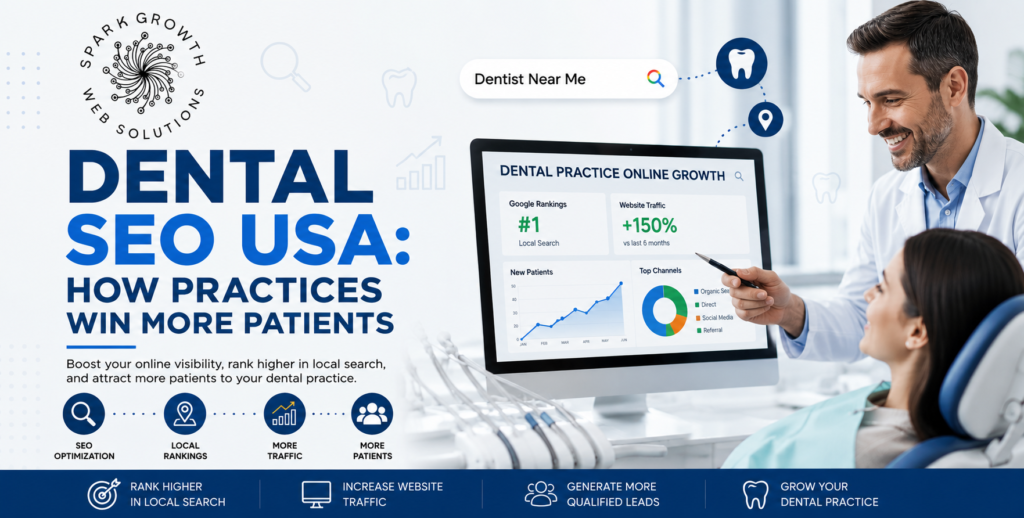
Patients no longer flip through a phone book or ask a neighbor for a dentist recommendation, they open Google, type “dentist near me,” and choose from whichever three or four practices show up first. That single shift in behavior is why SEO for dental practices USA has become one of the highest-leverage investments a dental clinic can make in 2026, whether you’re based in California, Texas, Florida, New York, or Illinois.
At SparkGrowth Web Solutions, we specialize in building websites and search strategies specifically for dental practices, combining local SEO for dentists, conversion-focused web design, and AI-search-ready content to turn local searches into booked appointments. This guide walks through exactly what’s working for dental practices across the USA right now.
1. Why Dental SEO Matters More Than Ever in 2026
Most patients today research a dentist online, comparing reviews, treatment options, and pricing transparency, before they ever pick up the phone to call. A dental practice without a strong, optimized online presence is effectively invisible to the majority of prospective patients in its area, no matter how good the in-office experience is.
This is especially true in competitive metros. A practice in Los Angeles, California or Houston, Texas is competing against dozens of other clinics for the same handful of local pack positions on Google. Meanwhile, practices in smaller markets across Florida or Illinois often have an easier path to ranking, but only if they actually invest in the fundamentals rather than assuming a nice-looking website is enough.
A dental marketing agency that understands this distinction, building strategy around your specific market’s competition level rather than applying a one-size-fits-all template, consistently outperforms generic web design shops that treat every clinic the same.
2. Google Business Profile: Your Highest-Leverage Asset
For dental practices, Google Business Profile (GBP) optimization is often the single fastest lever to pull for visible results. It is free, it is what most patients see first, and it directly determines whether your practice appears in the local 3-pack for searches like “dentist near me” or “emergency dentist in Chicago.”
What a Fully Optimized GBP Looks Like
- Specific categories, not generic ones: Don’t just list “Dentist.” Add “Cosmetic Dentist,” “Dental Implant Provider,” or “Emergency Dental Service” depending on what you actually offer, Google rewards specificity when matching searches to listings.
- Geo-tagged photos: Upload real photos of your practice, interior, exterior, team, tagged with your precise location coordinates. This is a small technical step most practices skip.
- Consistent, recent reviews: A steady flow of new reviews matters more than a large historical total. Practices with 100+ reviews and a high click-through rate from local search consistently out-rank competitors with fewer, older reviews.
- Accurate service area and hours: Especially important for multi-location practices across different parts of Texas or California, where each location needs its own fully built-out profile.
If your practice has locations in more than one city or state, resist the temptation to manage this with a single shared listing. Each location needs its own dedicated, fully optimized profile to rank in its specific area.
3. Treatment-Specific Landing Pages: The Underused Growth Lever
One of the most common mistakes we see in dental practice websites is a single, generic “Services” page trying to rank for everything, cosmetic dentistry, implants, orthodontics, emergency care, all crammed into one page. This almost never ranks well for any of those terms individually.
Instead, practices that build dental practice website design around individual, keyword-targeted pages for each major service consistently outperform. A page built specifically to answer how to get more patients for a dental practice in the USA-style search intent around dental implants will outrank a generic services page every time, because it’s directly answering what the searcher typed.
A Practical Page Structure
- Homepage: clear value proposition, prominent booking CTA, trust signals (reviews, credentials)
- Individual service pages: Implants, Invisalign/Orthodontics, Cosmetic Dentistry, Emergency Dental Care, Pediatric Dentistry
- Location pages: one per physical office, especially important for practices spanning multiple cities in Texas, Florida, or California
Patient resources / FAQ, structured for both traditional search and AI search visibility
4. AI Search Is Already Changing How Patients Find Dentists
Patients are increasingly asking AI assistants like ChatGPT, Claude and Google AI Overviews questions like “best dentist near me for implants” or “what’s the average cost of Invisalign in New York”, and getting direct, synthesized answers rather than a list of links to click through.
To show up in these AI-generated answers, your website content needs to be structured clearly, direct questions followed by direct, well-organized answers, rather than long unstructured paragraphs. This is exactly the kind of content structure SparkGrowth Web Solutions builds into every dental website, positioning practices to be the source AI tools pull from and cite.
This matters more every month. Practices that ignore AI search entirely are ceding an increasingly meaningful share of patient discovery to competitors who have adapted their content structure.
5. Mobile Booking and Conversion: Closing the Gap Between Visit and Appointment
Getting a patient to your website is only half the job, converting that visit into a booked appointment is where many dental websites quietly leak leads. A large share of dental practices still don’t offer online booking at all, forcing every prospective patient to call during business hours, which loses a meaningful percentage of interested visitors who’d rather book instantly.
Conversion Essentials for Dental Websites
- A simple, mobile-friendly booking widget directly on service pages — not buried three clicks deep
- Clear, visible phone number and click-to-call functionality on mobile
- Fast page load times — slow-loading pages lose visitors before they even see your booking option
- Trust signals near the CTA — reviews, before/after galleries, and credentials placed close to the booking action, not just on a separate “About” page
Is Your Business Website Not Visible On Google? Get It Ranked On #1 Page With Us!
- Google #1 page ranking for targeted keywords
- Rank #1 on your local maps
- Increased brand engagement & sales
6. A Practical Local SEO Checklist for Dental Practices
Whichever state you are in, California, Texas, Florida, New York, or Illinois, this checklist applies:
- Claim and fully complete your Google Business Profile with specific categories, geo-tagged photos, and accurate hours.
- Build individual, keyword-targeted pages for each core treatment rather than one blended services page.
- Add FAQ sections in clear, direct-answer format to support both traditional and AI search visibility.
- Set up an automated post-appointment review request flow.
- Add a mobile-friendly online booking widget directly to service pages.
- Ensure your website loads quickly on mobile, this directly affects both rankings and conversion rate.
- Add LocalBusiness and FAQPage schema markup so search engines and AI tools can understand your content structure.
- Track performance in Google Search Console, filtered by location if you operate multiple offices.
7. Common Mistakes That Cost Dental Practices Patients
- One generic services page instead of treatment-specific pages: This is the single biggest missed opportunity we see in dental websites.
- Inconsistent NAP (name, address, phone) data across the website, Google Business Profile, and directories, this quietly erodes local ranking potential.
- No structured review generation system, waiting passively for reviews falls behind practices that request them systematically after every visit.
- No online booking option, a friction point that costs conversions even when the SEO work is done well.
- Ignoring AI search entirely, as more patients turn to AI assistants for recommendations, practices with no structured content simply aren’t part of the conversation.
8. Building Long-Term Patient Value, Not Just First Visits
A strong digital strategy shouldn’t stop at the first booked appointment. Dental practices that build systems to retain patients and generate referrals get significantly more value from every marketing dollar spent, because the cost of keeping an existing patient is far lower than acquiring a new one.
Extending Value Beyond Acquisition
- Automated recall reminders— email or SMS reminders for six-month checkups keep your chairs filled without ongoing ad spend for every visit.
- Post-treatment review requests— timed shortly after a positive experience, when patients are most likely to leave detailed, enthusiastic feedback that helps future search visitors decide to book.
- Referral-friendly website design— a simple, shareable “Refer a Friend” page with a clear incentive turns satisfied patients into an ongoing acquisition channel at close to zero marginal cost.
- Content that builds long-term trust— blog content answering common patient questions (recovery times, insurance coverage, what to expect at a first visit) keeps your practice visible in search long after the initial campaign that brought a patient in the door.
This is the layer that separates dental practices seeing steady, compounding growth from those stuck restarting their marketing effort from zero every quarter. SparkGrowth Web Solutions builds these retention and referral mechanics into every dental website alongside the acquisition-focused SEO and paid strategy.
Are You Struggling To Generate Sales? Let Paid Advertising Turn Your Woes To Business Triumphs!
- Attract targeted potential audience
- High conversion rate
- Boost in Return On Investment (ROI)
Why Dental Practices Across the USA Choose SparkGrowth Web Solutions
SparkGrowth Web Solutions works specifically with dental practices across the United States to deliver:
- WordPress website design built around patient conversion, not just aesthetics
- Local SEO for dentists, including full Google Business Profile setup and management
- Treatment-specific landing pages structured to rank and convert
- AEO/GEO (AI search) optimization so your practice shows up in ChatGPT and Google AI Overview answers
- Google Ads management for practices that want immediate patient inquiries alongside long-term SEO growth
Whether your practice is based in California, Texas, Florida, New York, or Illinois, the strategy stays consistent: a fast, trustworthy, locally-optimized website, backed by SEO and AI search visibility, that turns local searches into booked patients.
Conclusion
The dental market across the USA is only getting more competitive online, and the practices pulling ahead aren’t necessarily the ones with the best in-office experience, they are the ones patients can actually find, trust, and book with the least friction. A practice in Texas or Florida no longer wins new patients purely on word-of-mouth; it wins by showing up first in local search, loading quickly on mobile, and answering a prospective patient’s questions clearly, whether they are searching on Google or asking an AI assistant for a recommendation. Getting the fundamentals right, a properly optimized Google Business Profile, treatment-specific landing pages, consistent recent reviews, and content structured for both traditional and AI search, puts a practice well ahead of the many competitors still relying on a single generic homepage and a phone-only booking process.
Ready to Attract More Patients?
SparkGrowth Web Solutions helps dental practices across the USA build websites and search strategies that turn local searches into booked patients. Contact us to get started.
Frequently Asked Questions
Costs vary based on your market’s competition level and how many locations you operate, but most practices should expect an ongoing monthly investment in SEO alongside any paid advertising, with results building steadily over 3–6 months.
The fastest-moving combination is a fully optimized Google Business Profile, treatment-specific landing pages, and a consistent review-generation process — in that order of priority.
Focus on GBP category accuracy, geo-tagged photos, consistent recent reviews, and NAP consistency across your website and directories — these are the strongest local pack ranking factors.
Yes — patients are already asking AI assistants for dentist recommendations. Structuring your website content in a clear, direct-answer format now positions your practice ahead of competitors who haven’t adapted yet.